- Think About It
- Posts
- What Autumn Teaches About Being Human
What Autumn Teaches About Being Human
From Elizabeth Barrett Browning’s verses: Lessons on stillness, sorrow, and the quiet acceptance of impermanence.

Zaid Pathan
October 18, 2025
Hello curious souls, welcome back to another edition of Think About It.
If you’ve known me for a while, you’d know how much I adore the autumn season and anything related to it.
It will be such a shame if I don’t take this opportunity (or excuse) to talk about it. Seasons have always been a major talking point for many great poets and philosophers. It’s because nature can reveal many secrets of life, and it can also be a source of wisdom and inspiration. Autumn is no different.
In this newsletter, we will discuss a poem called The Autumn by Elizabeth Benette Browning. And I will showcase some of my autumn photography in between ;)
The Autumn is one of those poems that quietly folds together nature, memory, and the melancholy of change. It looks deceptively simple, but it is profoundly layered.
Let’s go through it stanza by stanza:
Go, sit upon the lofty hill,
And turn your eyes around,
Where waving woods and waters wild
Do hymn an autumn sound.
Browning immediately captures the reader’s attention with the opening line. It’s like some instruction from the poet to sit and observe nature. Don’t mistake it as an escape. Here, she implies it as an active choice to position yourself for contemplation.
Notice “lofty hill”, by which she's asking you to gain perspective, to see things from a distance.
Next, the choice of the word “hymn” is masterful. That is because hymns are sacred songs, often associated with some kind of praise or worship. This gives the scene a sacred stillness. It’s like nature sings its own elegy.
This opening establishes the poem's central tension: we're being asked to witness something uncomfortable. We need distance to truly see change happening, to understand its patterns rather than being swept up in them.

Autumn scenery from the Lake District.
The summer sun is faint on them —
The summer flowers depart —
Sit still — as all transform'd to stone,
Except your musing heart.
Here's where Browning introduces loss directly. The summer sun is "faint", meaning not gone, but diminished. The flowers "depart". Notice the gentle verb, as if they're choosing to leave rather than dying. This softens the blow while not denying the reality.
Then, the poet makes us aware that everything in nature is changing. But the human heart, capable of thought and memory, remains awake.
There’s a tension here: the outer world stills and fades, but inner consciousness grows alive.
How there you sat in summer-time,
May yet be in your mind;
And how you heard the green woods sing
Beneath the freshening wind.
Now the poem shifts to memory. It asks you to recall what this same place was like during the summer.
It’s a gentle reminder that every loss is compounded by the memory of what you once had. Maybe that’s why change hurts. Not only does it remind you of what's gone, but it also reminds you of what it was like before.
In this stanza, Browning quietly reveals the philosophy of impermanence: nothing remains untouched by time, not even our recollections of happiness.
Though the same wind now blows around,
You would its blast recall;
For every breath that stirs the trees,
Doth cause a leaf to fall.
This stanza turns the earlier image against itself. The same wind that once “freshened” is now responsible for barrening the trees.
Through the second line, the poet suggests that you'd prefer to remember the wind as it was, not as it is now.
There’s some philosophical depth here as well. It is revealed how change transforms the meaning of things. The wind is neutral; it's just air movement. But depending on the season of life you're in, the same force can be life-giving or destructive. This is a profound observation about how our circumstances determine our experience of the world.

Calming autumn colours (Peak District, Derbyshire)
Oh! like that wind, is all the mirth
That flesh and dust impart:
We cannot bear its visitings,
When change is on the heart.
In this stanza, we can say for sure that the poem is not just about autumn. Browning is using it as a mirror for the soul’s seasons. She acknowledges the fragility of earthly happiness, which is temporary, contextual, and vulnerable to the seasons of the heart.
We're reminded of mortality and of our physical nature. When our internal season changes to autumn—when we’re grieving, or when we have lost something essential—we cannot tolerate the same things that once brought us joy.
This resonates so deeply because it names something we've all experienced: that strange alienation from joy when we're miserable and in pain.
Gay words and jests may make us smile,
When Sorrow is asleep;
But other things must make us smile,
When Sorrow bids us weep!
This verse is moral as much as emotional. Here, Browning distinguishes between surface-level happiness and deeper consolation.
When sorrow is merely "asleep" — dormant but not gone — superficial amusements ("gay words and jests") might work temporarily.
But "When Sorrow bids us weep" — when grief is active and demanding — shallow distractions fail. We need "other things" to sustain us, though she doesn't yet say what those things are. The poet might be hinting at some profound meaning for healing that can be achieved through love, faith, or truth.
Notice the personification of sorrow as something that "bids us weep". We don't choose when to grieve; grief chooses us.
The repetition of "make us smile" in both lines creates an almost ironic echo. The same words applied to different circumstances reveal their inadequacy. Not all smiling is the same; not all comfort works in every season.
The dearest hands that clasp our hands,—
Their presence may be o’er;
The dearest voice that meets our ear,
That tone may come no more!
This might be the most emotionally heavy stanza in the poem. Browning moves from metaphor to experience: death, absence, the silencing of love. There’s also emotional specificity here about hands, voices, presence, and absence.
This makes us confront mortality. All the abstract discussion of seasons and winds comes down to this: the people we love die. Their physical presence disappears. The specific, irreplaceable qualities that made them them — the way their hand felt in yours, the sound of their voice — vanish forever.
This teaches us to accept that love’s value lies in its impermanence. We cherish because we must lose.
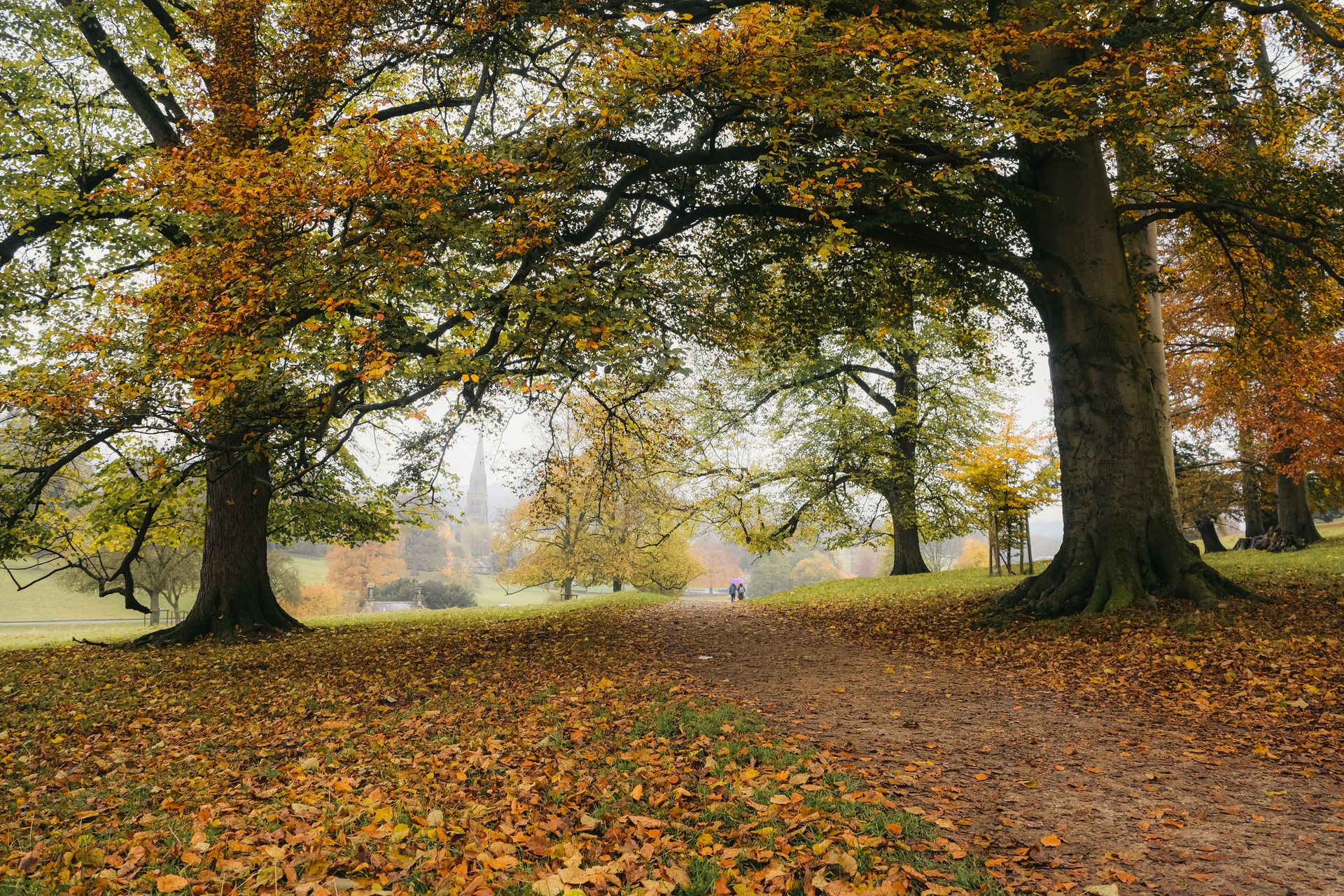
Nature draped in shades of amber and gold (Edensor Village)
Youth fades; and then, the joys of youth,
Which once refresh'd our mind,
Shall come — as, on those sighing woods,
The chilling autumn wind.
The poet returns to the central metaphor, but now it's personal and temporal. Notice "Youth fades", how it’s stated flatly, without elaboration, because it's undeniable.
The autumn wind now stands as time itself, once “freshening,” now “chilling.” That tells us that what once sustained us eventually becomes what reminds us of loss.
This is a reminder of how aging transforms our relationship to our own past. The happy memories of youth don't comfort us; they become another form of loss, another reminder of what we can't reclaim. This is why nostalgia can be so painful.
Hear not the wind — view not the woods;
Look out o'er vale and hill-
In spring, the sky encircled them —
The sky is round them still.
After eight stanzas of confronting loss and grief, Browning suddenly commands: Stop dwelling on the immediate signs of decay. Look beyond them. Look at the sky.
The sky hasn't changed. Seasons shift, people die, youth fades, but the sky — representing something permanent, something transcendent — remains constant.
The sky could be several things: the eternal, the divine, the unchanging backdrop against which all earthly change occurs.
This is the poem's answer to the problem of impermanence: seek what doesn't change. But notice how earned this answer is. The poet has spent eight stanzas refusing easy comfort, forcing us to really feel the weight of loss before offering any consolation.
Come autumn’s scathe—come winter’s cold—
Come change—and human fate!
Whatever prospect Heaven doth bound,
Can ne’er be desolate.
The final stanza is a defiant acceptance.
"Come" is repeated three times, which transforms passive endurance to active challenge. Bring on autumn's harm ("scathe"), bring on winter's coldness, bring on change and mortality ("human fate"). I can face it.
Any view, any landscape, any life circumstance that exists within Heaven's boundary — within divine context, or cosmic order — cannot be ultimately empty or meaningless.
What makes The Autumn philosophically profound is how it uses a natural metaphor to explore the deepest human questions: How do we bear loss? How do we live with the knowledge that everything we love will fade? Is there consolation that isn't merely a distraction?
The poem is profound because it doesn't lie to us. The poet forces us to really feel the weight of impermanence — the falling leaves, the fading youth, the lost voices — before offering any comfort.
Before concluding, here’s something for you to think about:
How do you balance the brief sweetness of worldly joy with the awareness of its impermanence? Is joy lesser because it doesn’t last or more beautiful because it doesn’t?
Can autumn, the symbol of decline, also be seen as a moment of truth, when life reveals what is essential after all embellishments have fallen away?
That’s all for this week.
Until next time
Stay curious
Zaid
Reply